

Weather in Thailand during May is hot, humid, and poised at the threshorange fromonsoons. Temperature readings during the day lie between 32°C to 35°C (90°F to 95°F), and during the night they do not drop below 24°C (75°F). In fact, the Meteorology Department of Thailand officially announces that the start of the rainy season comes somewhere in the middle of May in Thailand. It is interesting to note that rains come in sudden spells in the afternoons rather than the dreary all-day showers.
Koh Samui Islands off the Gulf Coast get the driest climate in the country. That is a short description of the climatic conditions in May. What follows is a more detailed answer to your question because Thailand Weather in May depends very much on which coast you choose and at what time. For example, Phuket receives an average of 300 mm of rainfall in May. On the other hand, Koh Samui, which is located just across the peninsula from Phuket, receives an average of 130 mm.
The Short Version:
In case you only have a minute, here is the whole month in one chart.
| What you want to know | May in Thailand |
|---|---|
| Daytime highs | 32 to 35°C (90 to 95°F) in most places |
| Night-time lows | 24 to 27°C (75 to 81°F) |
| Rainy days | About 11 to 19, depending on the region |
| Sea temperature | Around 30°C (86°F) on both coasts |
| Driest area | Gulf islands: Koh Samui, Koh Phangan, Koh Tao |
| Wettest tourist area | Andaman coast: Phuket, Krabi, Khao Lak |
| Monsoon start | Declared mid-May in each of the last three years |
| Travel season | Low season, with softer hotel rates |
Thailand Weather in May at a Glance:
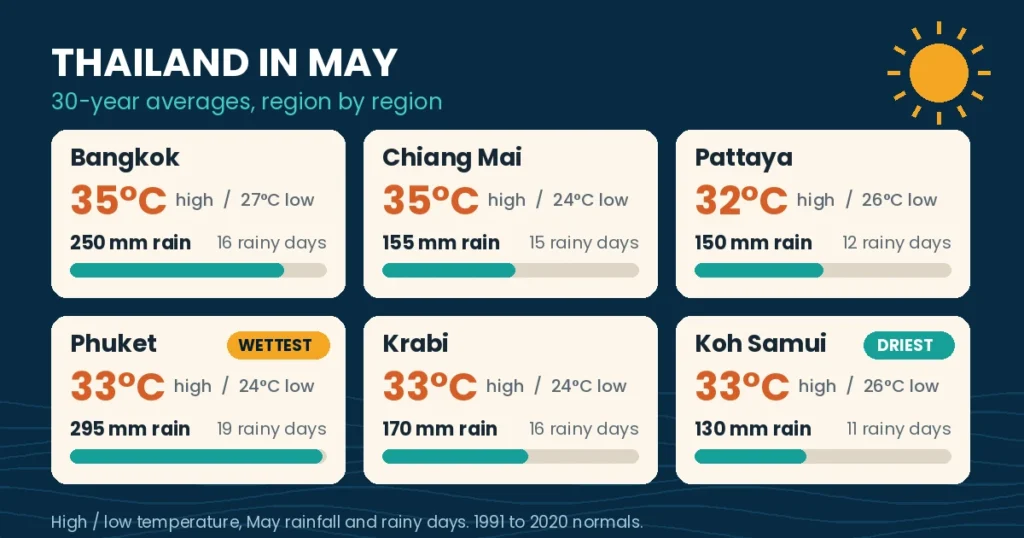
These are averages calculated for the 1991–2020 climate period, which is the base period that weather offices currently use for all their calculations. A wet day is a day with a minimum of 1mm of precipitation, meaning an evening downpour carries the same weight as a heavy rain shower.
| Destination | Avg high | Avg low | Rainfall | Rainy days | Daily sun |
|---|---|---|---|---|---|
| Bangkok | 35°C (95°F) | 27°C (81°F) | 250 mm | 16 | 7 hours |
| Chiang Mai | 35°C (95°F) | 24°C (75°F) | 155 mm | 15 | 6 hours |
| Pattaya | 32°C (90°F) | 26°C (79°F) | 150 mm | 12 | 5 hours |
| Phuket | 33°C (91°F) | 24°C (75°F) | 295 mm | 19 | 5 hours |
| Krabi | 33°C (91°F) | 24°C (75°F) | 170 mm | 16 | 5 hours |
| Koh Samui | 33°C (91°F) | 26°C (79°F) | 130 mm | 11 | 6 hours |
Two things are evident right off the bat. There is no variation in temperature as one moves north to south, making heat a constant in any area. The rain varies, and the difference between Phuket and Koh Samui is greater than that between Bangkok and Chiang Mai.
Why May Is Thailand’s Turning-Point Month:
The country of Thailand experiences three seasons. Cool and dry weather begins in November and ends in February; hot weather starts in March and ends in May, and the southwest monsoon takes charge from roughly mid-May through October. May is situated right in the middle of the latter two seasons.
During the month, the direction of the wind changes to bring warm and moist air from the Andaman Sea and Indian Ocean. When declaring the beginning of the rainy season, the Thai Meteorological Department doesn’t act on its whims. It waits for three signs: rains covering 60% of upper Thailand, winds blowing southwesterly at the surface level, and easterly winds in higher altitudes. If there is any storm before then, it will be referred to as pre-monsoon thunderstorms no matter how much rain they cause.
If the rains have been declared to begin, the upper region of Thailand will experience them until mid-October. In contrast, the east coast of the southern peninsula will receive most of its rain in November and December. This difference is the key to understanding May, which separates Koh Samui from the rain in Phuket.
Early May Versus Late May:
The first part of the month remains to be quite like that of the summer period. The skies will brighten, temperatures rise throughout the day, and there will be thunderstorms by the end of the day or night, which will clear off. For northern destinations, the remaining haze of the burning season will finally be cleared by the onset of the first rainfall.
In the second half of the month, things change with the arrival of the monsoon. Clouds will become frequent, showers more common, and afternoon high temperatures will lower by a couple of degrees. The other thing that changes for Andaman Islands is the ocean itself, as the swell becomes higher, and trips by boats get canceled on stormy days.
Here’s the bottom line: if heat bothers you more than rain, late May is better. If you want the highest probability of sunny weather at the beach, the first half is your choice.
Bangkok Weather in May:
Bangkok has a high of 35°C (95°F) and a low of 27°C (81°F) in May, and the temperatures do not drop at night either. Everything – the concrete buildings, traffic and emissions from the air conditioners keep the temperature warm, and at night the temperature remains quite close to that during the day.
Rain is something what tourists are not ready for in Bangkok. Bangkok receives 250 mm (9.8 inches) of rain in about 16 rainy days during May, making it rainier on average than both June and July. It rains during the afternoons and evenings in a few hours, pouring out plenty of water. At some level roads get flooded with the water and cars go slowly until the drainage system gets rid of it. The highest temperature in Bangkok during May within last several decades was 40°C (104°F) in May 2019.
Solution is very simple in this situation: visit the Grand Palace, Wat Pho and Wat Arun in the morning, do shopping and visit other sights in the afternoon and use BTS Skytrain, MRT or boat instead of the taxi if it starts raining.
Chiang Mai and Northern Thailand in May:
Average temperatures in May are 35°C (95°F) during the day and 24°C (75°F) at night. This is a slight decrease from the averages of about 37°C (99°F) that are typical in April, which is important not just because of the temperature change but due to better air quality.
Throughout winter and early spring, farmers in the northern part of the country burn crop residue, with the smoke staying in the valleys, reaching its maximum levels in March. The rains in May cleanse the air; however, early May may still have a haze year with little rainfall. Average precipitation totals 155 mm (6.1 inches) within 15 days. Late May sees new greenery on the mountains, replenishment of Doi Inthanon waterfalls, and muddy paths through the forests. Even more precipitation falls in Chiang Rai farther north, around 225 mm.
Phuket, Krabi and the Andaman Coast in May:
The west coast faces the monsoon squarely, owing to the southwest rain-bearing winds coming directly from the open ocean. Phuket receives up to 295 mm (11.6 inches) of rain in about 19 days in May, with up to five hours of sunshine per day. On the other hand, the same island will receive about 35 mm of rainfall in January. Krabi Island will experience about 170 mm of rainfall in 16 days, and temperatures will average 33°C (91°F) during the day.
Sea temperatures will average 30°C (86°F) but the sea will no longer be calm. Once the monsoon swells arrive, there will be red flags raised in west-facing beaches like Patong, Karon, and Kata because of rip currents that will pose threats to swimmers. Speedboat tours to islands like Phi Phi, James Bond Island and other islands in Thailand will take place when the weather conditions are favorable.
Others like the Similan and Surin islands and some dive spots in the Mu Ko Lanta national park, such as Koh Rok and Hin Daeng, close from mid-May to mid-October every year. On Koh Phi Phi Leh, the beach at Maya Bay remains accessible until May. The beach’s yearly closure takes place during August and September. Moreover, it is impossible to swim there during any other month of the year.
But there are still good things about it. The number of people drops, prices go down, the jungle gets greener, and having a sunny morning followed by rain in the afternoon from a covered deck works well as a vacation.
Koh Samui, Koh Phangan and Koh Tao in May:
The best place to have a beach experience in May would be at the Gulf of Thailand. This area experiences the southwest monsoon rain shadow as it lies within the lee of the mountain chain of the peninsula.
The month of May sees about 11 rainy days in Koh Samui with an average of 130mm (5.1inches). The maximum temperature is 33°C (91°F), and the minimum is 26°C (79°F). There are 6 hours of sunshine daily. In comparison, in November, the island of Koh Samui gets an average rainfall of 445mm. On the Gulf of Thailand side, the sea is calm and hence makes the diving and snorkelling trips to Koh Tao operational almost all the days.
Pattaya, Koh Chang and the East Coast in May:
Pattaya has average temperatures of 32°C (90°F) during the day, with 150 mm (5.9 inches) of rain in 12 days in May. May is one of the rainier months in Pattaya, like September and October, but with a bit of rain than June through August. This place suits you fine for a beach trip in May from Bangkok.
If you continue your journey further towards the east, things will change quickly. Rainfall around Chanthaburi and Trat (Koh Chang entrance) is averaging at around 400 mm in 22 days of May. This coastal area is one of the rainiest places in Thailand, and May is definitely not its month.
What Past Mays Actually Looked Like:
Averages even out the extremes, so it would be good to examine actual years. This is what happened in each of the last three Mays according to the announcements made by the Thai Meteorological Department itself.
| Year | Rainy season declared | How May played out |
|---|---|---|
| 2024 | 20 May | Hot: National average is 1.3°C above normal; several new records set |
| 2025 | 15 May | Wet: Rainfall is 52% above normal for the country |
| 2026 | 15 May | Rains and waves of 2-3 meters high in the Andamans mid month |
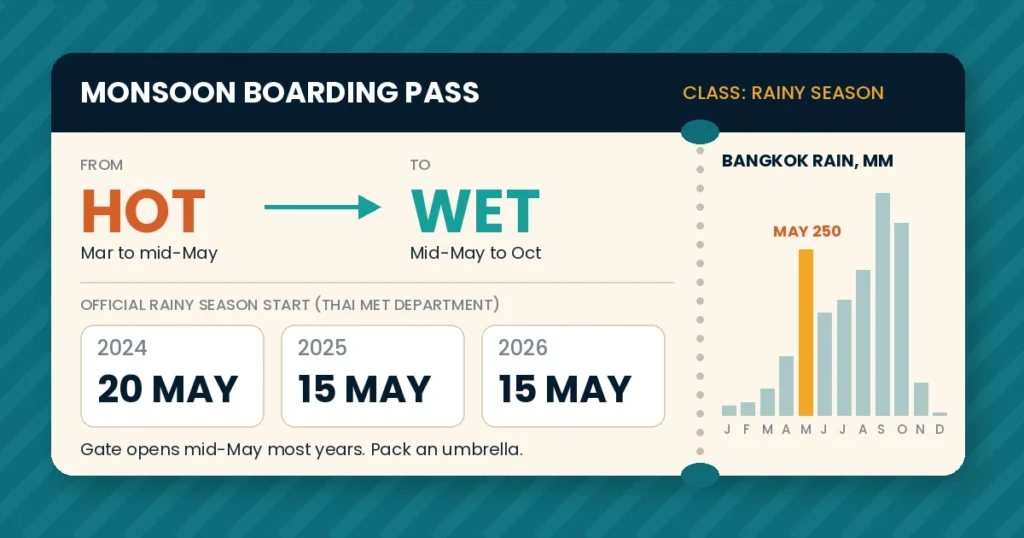
May 2024 was indeed the hottest month. It had less rainfall than expected throughout the entire month, several weather stations broke their highest temperature record, and the monsoon did not come until the end of the month, due to the effects of Cyclone Remal in the Bay of Bengal and Tropical Storm Maliksi in the South China Sea.
May 2025 was totally different. It rained a lot, every area had exceeded expectations, and 56% extra fell in the southern region on the Andaman coast. Some areas experienced floods, and several stations set new records for both daily and monthly rainfall amounts.
May 2026 also started on the same day as the previous year. The Department predicted the monsoon would be 10% drier than average but warned of heavy and very heavy rainfall from 14 to 18 May with swells of 2 to 3 m in the Andaman Sea and small craft advised to remain in port.
The extent to which May can stretch its limit can be understood by noting that Bangkok once registered 40°C (104°F), while the May record high for Phuket and the inland city of Tak is 38°C (100°F) and 43.8°C (110.8°F), respectively.
How Hot It Actually Feels:
35°C is not the same in the tropical Bangkok as in a hot desert city. Average humidity is 72% in May in Bangkok, and in the south, it exceeds 80%, while sweat won’t evaporate properly. The heat index that combines the humidity and temperature levels often exceeds the actual air temperature in the middle of the day.
Cooling at night is less effective than expected; the temperatures range from 24 to 27°C. Even the sea won’t help; it stays warm at 30°C on both coasts, which feels more like a hot bath rather than swimming. The hottest daytime walking should be done early in the morning and lunchtime is siesta time.
Is May a Good Time to Visit Thailand:
If it is the right vacation for you, then definitely yes! The month of May can be perfect for those who wish to travel in a budget-friendly manner and to enjoy the peace of mind, people traveling to the Gulf islands, city holidays with flexible days, and those people who enjoy the prospect of clean air in the north.
However, if all your plans depend on Andaman hopping, scuba diving in the Similans, and photographing for your wedding ceremony, then definitely no! May is not a good choice for you if you have trouble tolerating the heat in Bangkok and Central Plains in the early part of the month.
Where to Go in Thailand in May:
In light of the above considerations, this is how the major vacation spots compare for a May vacation.
| Destination | May verdict | Best for |
|---|---|---|
| Koh Samui, Phangan, Tao | Top pick | Beaches, snorkelling, diving |
| Bangkok | Good with a flexible plan | Food, temples, shopping, rooftop bars |
| Chiang Mai | Good, greener than April | Temples, cafes, cooking classes |
| Pattaya | Fair | Short beach break from Bangkok |
| Phuket and Krabi | Mixed but cheaper | Resorts, spas, low-season deals |
| Koh Chang and Trat | Poor | Wettest stretch of mainland coast |
May Festivals and Holidays Worth Planning Around:
However, May is not only about the climate. Just a few dates can affect your trip positively or negatively.
On 4 May, the nation celebrates Coronation Day, thus the streets are expected to be more crowded and many government departments will be shut. The Royal Ploughing Ceremony, celebrated in the Bangkok area (Sanam Luang) on a date decided by court astrologers, signals the beginning of the rice-growing period symbolically. This is a rather formal ceremony, however, still interesting to watch.
The Bun Bang Fai rocket festival takes place in the northeast of the country in the town of Yasothon in late May. Parades, fireworks, live music, and homemade rockets sent into the air for calling rain – all this happens over the weekend. Visakha Bucha is the most significant day of the Buddhist calendar. It is celebrated on a full moon of the sixth lunar month (normally May or early June). There are candlelit processions held in temples and alcohol is prohibited throughout the country.
It is also the season when fruits begin to ripen. The mangoes have ripened, and the durians, mangosteens and rambutans have started to reach the marketplaces from the orchards on the eastern side of Chanthaburi and Rayong. It can be said without doubt that the mango sticky rice tastes the best in May.
What to Pack for Thailand in May:
Consider light, fast drying and easy to layer for air conditioning. Loose cotton or linen clothing performs better in high humidity levels compared to synthetic ones, and a pair of sandal that can take flooded pavements will earn its rightful place very quickly. An umbrella will serve you better than a poncho in cities while poncho is a wise choice when traveling by motorcycle or long tail boat.
Reef safe high SPF sunscreen, hat, dry bags for carrying mobile phones when traveling by boat, and some electrolyte packets are needed. Cover yourself up at temples and carry an extra layer when visiting malls, buses and train in cold air conditioning.
Mistakes Travellers Make in May:
- Scheduling Similan Islands tour for late May, following closure of the park for the season.
- Interpreting “rainy season” to mean constant rain. Rainfall in May is usually brief and confined to afternoons and evenings.
- Squeezing Andaman island hopping schedule without time left for an emergency alternative day if the boat fails.
- Taking a dip from red flag areas on the beaches of Phuket’s west coast since the water appears invitingly warm.
- Visiting temples in the middle of the day in Bangkok and being rendered useless in the evening by heat exhaustion.
- Expecting the climate of Phuket and Koh Samui to be identical since they are located at the same latitude.
Thailand in May Trivia:
- The maximum temperature ever recorded in Thailand was 44.6°C (112.3°F), registered on 28 April 2016 in Mae Hong Son, just few days before May.
- May receives more rainfall than June and July in Bangkok despite the arrival of the monsoon just halfway through May.
- The largest type of Bun Bang Fai rockets is called Bang Fai Saen, which contain about 120 kg of gunpowder.
- While Koh Samui receives three times as much rainfall in November as compared to May, it is the reverse of the Phuket scenario.
- There is a daily limit of 3,850 visitors per day to the Similan Islands while the islands are closed during mid-May.
- The monsoon rains are officially declared if the area covered by rainfall is 60% and the wind changes direction twice.
Final Take:
Thailand weather in May rewards travellers who pick the right coast. Heat is expected in all places, storms in the afternoons more often than not, and the monsoon rains which usually start around mid-month. The Gulf Islands take preference over all other destinations for spending your time at the beach, the Thai capital and Chiang Mai should be treated as early morning and late evening places, while you visit Phuket or Krabi in order to benefit from the discounts and the vegetation, not from sunshine.
Frequently Asked Questions:
Yes, rainfall increases throughout Thailand during the month of May as the southwest monsoon starts blowing in mid-May. While all the regions receive rainfall ranging from 11 to 19 days, the rainfall occurs in form of showers in the afternoon or evening times, leaving mornings clear and sunny.
May is warm and tolerable if you time your activities accordingly. The maximum temperature rises to 32 to 35°C (90 to 95°F) making the weather hot due to humidity. The first half of May is the hot period whereas the second half becomes slightly cool with rain showers.
Gulf islands such as Koh Samui, Koh Phangan and Koh Tao are ideal destinations in May. Koh Samui receives an average rainfall of 130 mm in 11 days as opposed to 295 mm in 19 days in Phuket; in addition, the sea in Gulf coast is calm.
Swimming in Phuket during May is safe only on calm days and at beaches that have lifeguards and green or yellow flags. With the onset of the monsoon swell, red flags will be raised on the beaches of the western coast like Patong, Karon, and Kata due to the risk of rip currents.
Maya Bay is accessible in May, while the Similan Islands are closed from mid-May onwards. Similan and Surin Marine Parks close annually from mid-May to mid-October, meaning that trips there should occur before mid-May. Maya Bay remains open until its annual closure in August and September.
The rainy season typically begins in the middle of May. This was announced by the Thai Meteorological Department on 20 May in 2024 and on 15 May in 2025 and 2026 after rain spread across all of upper Thailand and the winds had shifted to the southwest monsoon.