
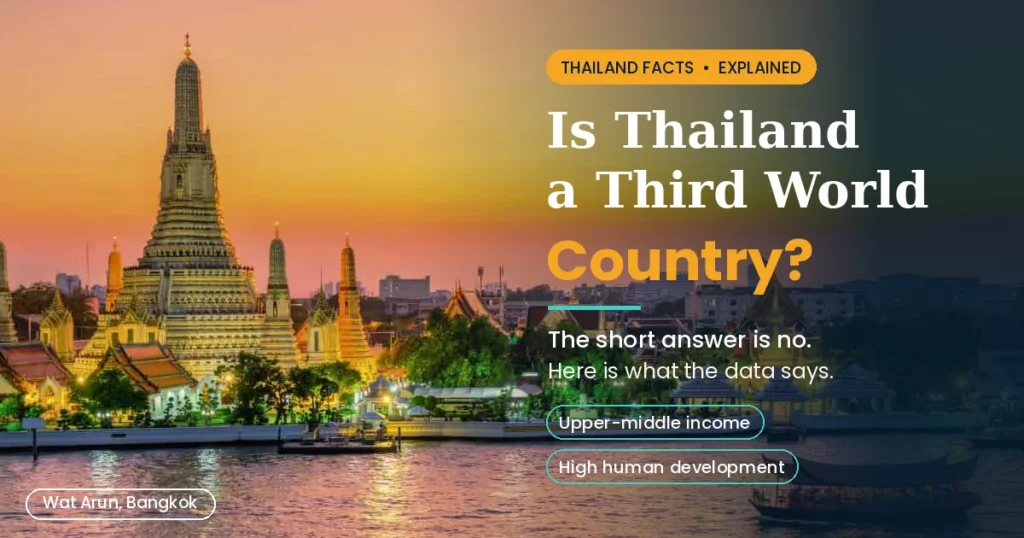
No, Thailand is not a third-world country. According to the World Bank, Thailand belongs to the group of upper-middle-income economies since 2011, while according to the UN Human Development Index it belongs to countries with high human development, ranking above the world average. In other words, Thailand is a developing or emerging country, one which has surpassed the stage of being poor but has yet to become a high-income country. Interestingly, there is a twist that most people are unaware of – according to the Cold War definition of the Third World, Thailand was never a part of it.
Is Thailand a third-world country is a question frequently raised. Because the term itself is now used not in its political but rather economic meaning of poor, combined with the fact that Thailand boasts both shining skyscrapers and rural areas within a couple of hours’ drive from one another. In this guide, we will discuss the history of the term, the current classification of Thailand and its comparison with other Asian countries, and what does it all mean for your upcoming vacation.
The Short Answer:
Here is Thailand’s position in one table.
| Question | Answer |
|---|---|
| Is Thailand third world? | No, by either the old or modern meaning |
| World Bank income group | Upper-middle income, since 2011 |
| GNI per capita (2025 data) | US$7,690 |
| High-income cut-off | More than US$14,375 |
| UN Human Development Index | 0.798, high human development |
| HDI world rank | 76th of 193 in the 2025 report |
| IMF grouping | Emerging market and developing economy |
| OECD status | Accession candidate, not yet a member |
| Size in Southeast Asia | Second-largest economy in the region |
Where the Term Third World Came From:
This expression originated in 1952, when French demographer Alfred Sauvy coined it in an attempt to refer to those countries not affiliated with any of the two main factions of the Cold War. Sauvy took inspiration from the concept of the Third Estate of pre-revolutionary France, the common people without representation in the nobility and church.
The original classification involved dividing the world into the First World, the USA and its allies, the Second World, the Soviet Union and its block, and the Third World, everyone else, predominantly the newly-independent states which remained non-aligned after their colonization. This was a political division, not an economic one.
In the following years, since the non-aligned states were generally impoverished, the term increasingly acquired the meaning of poor country in everyday use. The fall of the Cold War in 1991 resulted in the disappearance of political meaning of this term. Nowadays, economists, governments, and international organizations do not use it anymore because of its misleading nature and insulting tone.
Thailand Was on the First World Side:
According to the original meaning, Thailand was very much part of the West. For instance, it was a charter member of the Southeast Asia Treaty Organization, which was an anti-communist alliance established under the 1954 Manila Pact, with its headquarters in Bangkok until its dissolution in 1977.
In addition, Thailand was an American ally during the Vietnam era, even having American air bases stationed on its land. Moreover, Thailand had never been colonized, unlike the vast majority of its neighbors since Burma, Malaya, Indochina and the Philippines had all been colonized at some point.
Thus, the strictly historical answer is not only that Thailand is no longer third world but rather that it has never been.
How Thailand Is Officially Classified Today:
First, Second, and Third Worlds are no longer officially used terms. Four prominent organizations classify Thailand according to their particular scales, all of which now place it squarely in the middle-high range.
| Institution | Thailand’s category | What it measures |
|---|---|---|
| World Bank | Upper-middle income | Gross national income per person |
| UNDP | High human development | Health, education and income combined |
| IMF | Emerging market and developing economy | Economic structure and markets |
| OECD | Accession candidate | Policy standards of advanced economies |
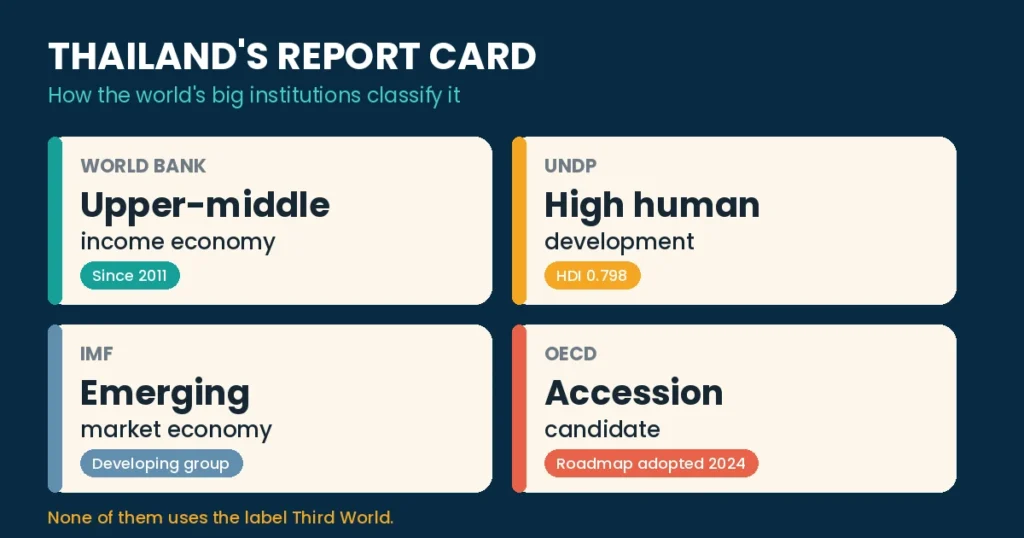
These figures are the most commonly cited. According to its classification from July 2026 until June 2027, the upper-middle income includes countries with gross national income per capita of US4,636toUS14,375. The figure for Thailand of US7,690fitswellwithinthisrange,beingroughlymidwaytowardshighincomeclassification.Itenteredthecategoryin2011havingpercapitaincomeofUS4,210.
The United Nations Human Development Index takes into account non-monetary criteria such as life expectancy and education level. Its rating for 2025 based on the 2023 data is 0.798, just missing the very high mark of 0.800. It was in the very high category in the previous year with the mark of 0.803, so Thailand is located precisely on the borderline between the two categories, not the bottom one.
Another attempt that Thailand is making is to join the OECD, an organization of mostly democratic developed countries. The discussions have started in June 2024, the accessions roadmap has been agreed in July 2024, and the goal of joining the organization has been set by the Thai government for 2028, though it does not give any deadline to the OECD.
How Thailand Compares With Its Neighbours:
The position that Thailand holds in Southeast Asia helps put things into perspective. In terms of the Human Development Index, there are just three nations that rank above it.
| Country | HDI score | UNDP category |
|---|---|---|
| Singapore | 0.946 | Very high |
| Brunei | 0.837 | Very high |
| Malaysia | 0.819 | Very high |
| Thailand | 0.798 | High |
| Vietnam | 0.766 | High |
| Indonesia | 0.728 | High |
| Philippines | 0.720 | High |
| Laos | 0.617 | Medium |
| Myanmar | 0.609 | Medium |
| Cambodia | 0.606 | Medium |
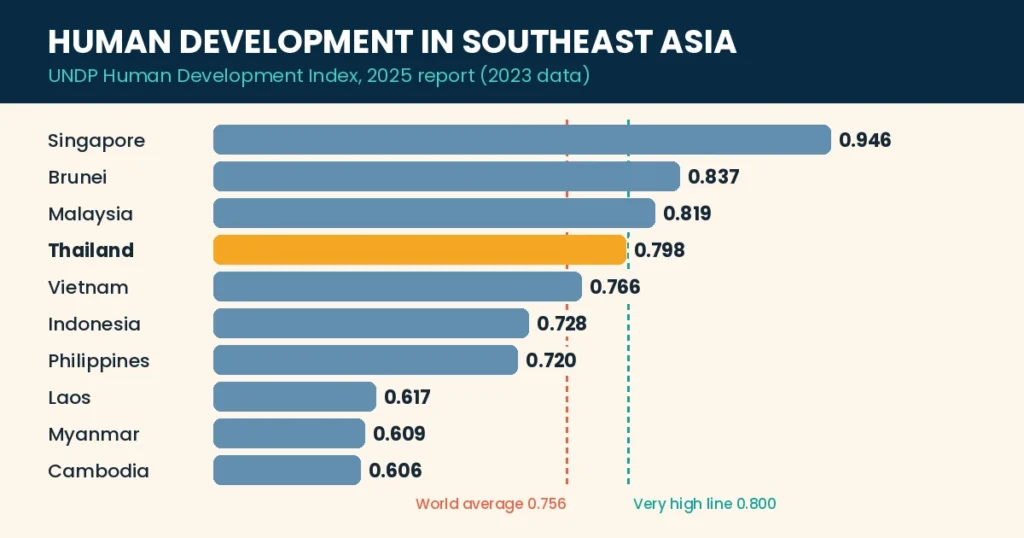
It is ranked as the fourth among the ten, beating the global average of 0.756 and the neighbouring countries of Laos, Myanmar and Cambodia. It has the second-largest economy in Southeast Asia after Indonesia.
What Upper-Middle Income Looks Like on the Ground:
The statistics can be found in the experience of travelers. The city has elevated BTS Skytrain and underground MRT train systems, Suvarnabhumi Airport is one of the busiest airports in Asia, and expressways connect the large cities. Internet data is inexpensive and fast, contactless payments and QR payments are ubiquitous in cities, and there is always a convenience store within walking distance.
Healthcare is another example of such an indicator. Thailand has been implementing a universal healthcare coverage scheme since 2002; that is, almost all citizens have health insurance. Private hospitals in Bangkok and Phuket attract medical tourists from all around the world. The education level is high, and Thai women perform better than Thai men on the Human Development Index; it is true for Thailand and Mongolia in Asia-Pacific.
Where Thailand Still Falls Short:
Nothing mentioned above suggests that Thailand is a wealthy country, and it is important to be realistic when discussing its problems. The most serious one is inequality. Adjusting for it, the Human Development Index of UNDP drops from 0.798 to 0.677, indicating that the gains of economic development are distributed disproportionately between Bangkok and provincial areas, as well as between wage laborers and people working in the informal sector.
Rural area in the northeast called Isan is less affluent than Bangkok, and quite a lot of Thai workers work in informal agriculture or as street vendors and earn money without any contracts and pension funds. Economists often refer to the so-called middle-income trap that Thailand has faced after growing fast into the upper-middle income category, whereas the climb into high income has become much harder, and Vietnam entered this income category for the first time ever in the classification by the World Bank.
Another important gap is the issue of road safety that concerns foreign travelers directly. The road fatality rate in Thailand is one of the highest in the world due to motorcycle accidents; therefore, it is necessary to be very cautious with scooter rentals.
What This Means for Travellers:
In places like Bangkok, Phuket, Chiang Mai, and other tourist destinations in Thailand, life is more akin to that of a modern city compared to what comes to mind when one hears the term “third world.” In such places, there are hotel accommodations for all categories; card transactions are widespread, ride-hailing services are standard, and English is prevalent in touristic destinations.
A few practices still hold true. Drink bottled or filtered water in place of tap water, since most Thai people don’t drink tap water as well. Take along some cash for the markets, the street food scene, and rural destinations. Purchase travel insurance that covers both private hospitals and accidents on motorbikes, as the care at private hospitals is top-notch but costly.
Better Words to Use Than Third World:
While trying to characterize Thailand in simple terms, there are several terms that will be suitable, yet none of them carries any unnecessary associations. The developing country or emerging economy will work well as a reflection of its economic development status compared to developed countries. An upper-middle-income country will be the most accurate term to use because it perfectly fits into the same category used by the World Bank.
Third world implies that there is a set of poor countries, which is not true, as Thailand cannot be grouped with countries where people earn much less than the citizens of Thailand.
Common Myths About Thailand’s Development:
- Myth: Thailand is a poor country. Thailand is upper-middle income, and far surpasses the threshold of lower-middle income internationally.
- Myth: Third World is an official classification. It is not used by any major international institution anymore.
- Myth: Thailand used to be a colony. It is the only Southeast Asian nation that was never colonized by Europeans.
- Myth: Thailand is behind other nations in the area. In human development, it is ranked fourth among the ten Southeast Asian nations.
- Myth: Healthcare is basic all over. There is near-universal coverage, with even private hospitals attracting health tourists.
- Myth: Development is uniform all around the nation. There is still a large disparity between Bangkok and the rest of the country.
Thailand Development Trivia:
- The name ‘Third World’ was coined in 1952 by French demographer Alfred Sauvy.
- SEATO, a Cold War Western military alliance, had its seat in Bangkok from 1954 to 1977.
- Thailand became an upper-middle-income country in 2011 with per capita income at US$4,210.
- Thailand and Mongolia are the only Asia-Pacific nations where HDI of women exceeds that of men.
- Thailand’s HDI was 0.503 in 1980 and it surpassed 0.800 for the first time in 2019 data.
- Thailand became the second Southeast Asian nation to initiate OECD accession talks after Indonesia.
Final Take:
Is Thailand a third world country? No matter how it is measured, it simply will not do. The country is part of the West where the term originated, it is a high-income economy since 2011, and it falls between high human development and very high human development levels. The truth is that it is a developing country and upper middle income, with urban areas, inequalities, and a rural area with a slower pace of life. This translates for visitors into modern cities, private healthcare facilities, and much more than the stereotype can encompass.
Frequently Asked Questions:
Thailand is a developing nation; it is considered to be an upper-middle-income economy according to the World Bank classification system and an emerging market economy according to the IMF classification system. Though it has not yet achieved the high income threshold of over US$14,375, Thailand is considerably higher than the income levels that are characteristic of poor nations.
No, Thailand is not a poor nation; its gross national income per capita is US$7,690, and therefore, it is classified under the category of upper-middle income nations. There are instances of poverty in Thailand, particularly among the rural poor and the working poor, but generally, the nation is above the world average in human development.
Thailand cannot be referred to as a first world nation at present since it has not yet achieved high income status; however, historically, Thailand was a member of the First World, having been an ally of the United States and a member of SEATO with headquarters in Bangkok.
The Human Development Index score for Thailand is 0.798 in the 2025 UNDP report, which places it at 76 out of 193 countries and regions. Thus, it falls under the category of high human development, right above the 0.800 threshold for very high.
Yes, Thailand is an emerging market. The IMF considers it among emerging markets and developing economies and it is the second largest economy in Southeast Asia. It has also started the process of becoming a member of the OECD with a vision to join by 2028.